


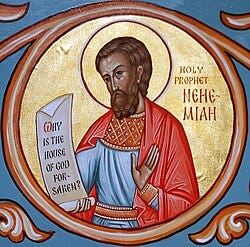
In his first encyclical, Magnifica Humanitas, Pope Leo XIV focuses on the symbolic contrast of the building of the Tower of Babel and the building of the walls of Jerusalem by Nehemiah. The argument is that the building of Babel used an arrogant and irreverent mindset of domination and single-mindedness, while Nehemiah’s building of Jerusalem sought to incorporate the members of the community into a project of building with and for God, stating, “He [Nehemiah] did not impose solutions from above. He convened the families, assigned each of them a section of the wall to rebuild, listened to their concerns, coordinated their efforts and addressed any opposition.”1 Many have found Leo’s overall comparison compelling and helpful, but will anyone in the digital world actually want to implement it?
While there is no opinion poll on Magnifica Humanitas in the tech industry (at least as far as I am aware), I do think there are some points indicating some potential avenues of adoption as well as some potential roadblocks to realization of Nehemiah’s methods in technological development that might be worth examining. Leo does not address any specific technical actions that we can put into practice, but some of his ideas do call to my mind some active efforts that are already promoting collaborative ownership of software and hardware. Perhaps the most obvious that comes to my mind is the use of open source projects. Open source, which is primarily used in software development, encourages individual collaboration and public visibility of a project, with anyone being able to view, contribute to, and build off of projects under an open source license.
Speaking from personal experience, open source has been of great appeal to almost everyone I have met in the Information Systems fields. I would argue that the majority of individual workers and employees, probably even those working with larger companies like Microsoft and Amazon, personally value being able to take ownership and control over their software, hardware, and data handling through initiatives like open source projects. Privacy is of paramount concern to them because they see how little of it we really have. I do hope that if Leo XIV continues to make tech developments a primary concern of his pontificate, that he can perhaps promote such initiatives that have already taken root in the digital world. The Vatican already participates in other sciences, why not in the Information Sciences? Could we see papal programmers in a similar vein to the Church’s dedicated astronomers? I am not aware of any indications in the affirmative, but we will have to wait and see.

In contrast, the biggest roadblock is that, while technicians and developers may be interested in increased ownership, I have little hope that they will want to build with and for God. It seems to me that there is not a strong conviction in the Information Sciences at large of a Catholic, Christian, or even just a Biblical understanding of the world. Now, I am not saying that there are not pockets of it, there certainly are, and I am not saying that everyone in tech is a reprobate, although some certainly are. What I am saying is that there seems to me to be no inner conversion in the industry at large, and without that, I do not see how Leo XIV expects them to build with and for a God that they do not believe in or would prefer to keep out of their work.
I would apply the same concerns to most of the world’s nations as well, and I do worry that Leo may be misplacing faith in state or globalistic efforts to enact positive change in the industry. Many of these states want to reduce the privacy of their citizens, not increase it. Many of these states are leaning towards a denial of God and not an affirmation of Him. It seems to me to be a slim chance then that a state or collection of states would adopt and promote anything like a Catholic understanding of the world in their legislation. I would also be concerned that such intervention at that scale by its nature might lead more towards the hegemonic building of Babel that Leo XIV warns against than the collaborative building of Jerusalem.
Regarding ownership, I was surprised that Magnifica Humanitas did not seem to emphasize the importance of ownership and private property. It would seem to naturally follow from Leo’s description of Nehemiah’s building that an increased opportunity of small ownership might be called for. In his review of the encyclical, Dale Ahlquist stated,
“One could argue that the main point of Rerum Novarum is that ‘more workers should become owners.’ Leo XIV does not mention this at all. He does not acknowledge the importance of widespread ownership, which for Chesterton and Belloc was the key solution to modern social and economic problems. Subsidiarity is the small shop. Solidarity is the seed planted in the earth.”2
I think I agree with Dale Ahlquist that the encyclical would have been greatly helped with a recognition of the importance of ownership and private property. I was also surprised that Leo XIV did not mention the central importance of property to the family as the previous Leo did in Rerum Novarum.
“That right to property, therefore, which has been proved to belong naturally to individual persons, must in like wise belong to a man in his capacity of head of a family; nay, that right is all the stronger in proportion as the human person receives a wider extension in the family group. It is almost a sacred law of nature that a father should provide food and all necessaries for those whom he has begotten; and, similarly, it is natural that he should wish that his children, who carry on, so to speak, and continue his personality, should be by him provided with all that is needful to enable them to keep themselves decently from want and misery amid the uncertainties of this mortal life.”3
Property is a fundamental component of the family. I am almost inclined to argue that it exists for the family and because of the family. Historically, family and private property were inseparable. Private property is where the family put down its roots and derived its sustenance. I think that it is no mistake then that as real, substantial ownership in private property that generates wealth has decreased for many, many of us are also seeing a simultaneous decline in the family. The loss of property might mean, in part, the loss of family. It is for this reason that I was slightly concerned that Leo XIV seemed to downplay the importance of property rights and typically emphasized their service only to the “common good” without discussing the importance of the family. I can only end by saying that, yes, I wish there had been a Chesterton quote, but I will take the Tolkien quotes when I can get them.
Leo XIV, Encyclical Letter Magnifica Humanitas, 15 May 2026, 8.
Dale Ahlquist, “The choice: Rebuild the tower of Babel or rebuild the walls of Jerusalem”, The Catholic World Report, 26 May 2026, accessed 24 Oct. 2026, https://www.catholicworldreport.com/2026/05/26/the-choice-rebuild-the-tower-of-babel-or-rebuild-the-walls-of-jerusalem/?utm_source=Chesterton+Society+Newsletter&utm_campaign=65639ca123-EMAIL_CAMPAIGN_2026_05_27_02_51&utm_medium=email&utm_term=0_-65639ca123-478521757&mc_cid=65639ca123.
Leo XIII, Encyclical Letter Rerum Novarum, 15 May 1891, 13.